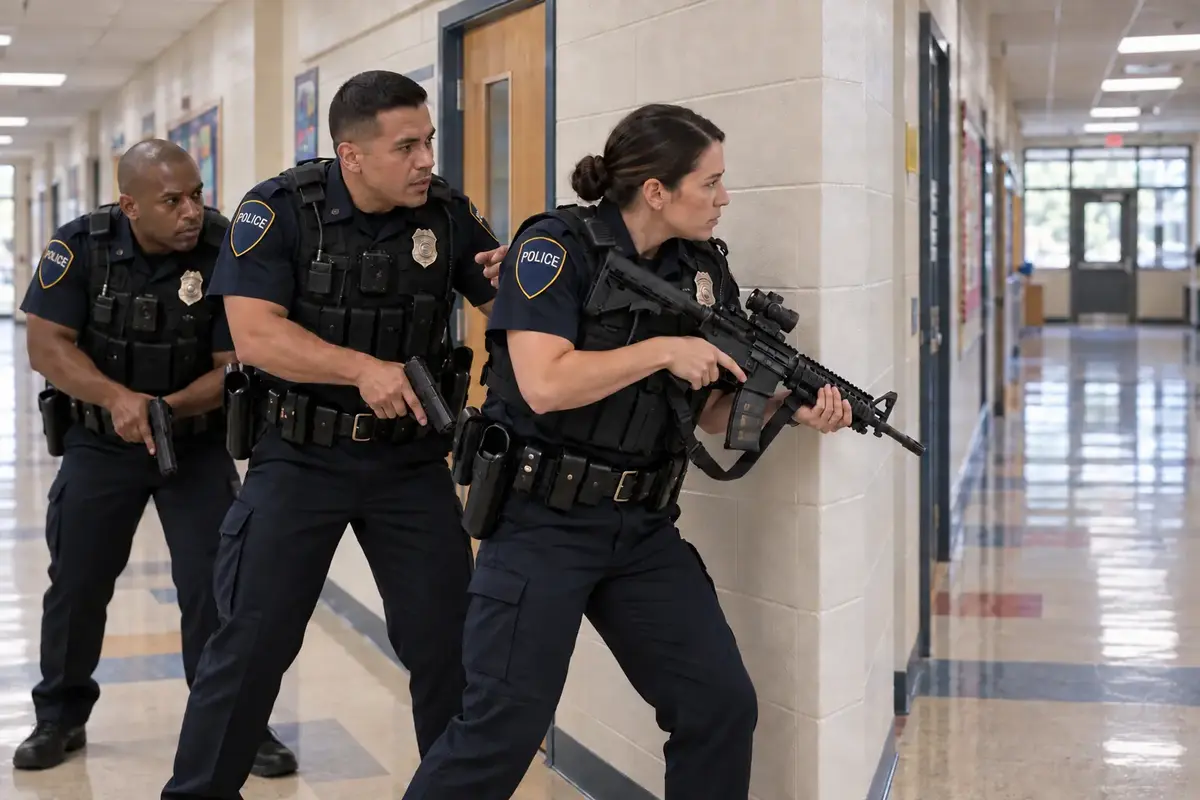
OFFICER SAFETY BULLETIN
Close the Scene Before You Review It
The urge to talk through a difficult call begins as soon as the action stops. That conversation must not pull attention from hazards that remain. Before an immediate debrief, confirm that people, weapons, evidence, traffic, medical needs, prisoners, witnesses, and scene security are under control. Make required notifications and preserve time-sensitive evidence. Treat the transition as an operational phase, not an automatic all-clear.
Today's Officer Safety Focus
- Conduct a deliberate status check: people, weapons, medical, evidence, traffic, communications, and remaining hazards.
- Request medical evaluation when facts, policy, or the person's condition indicate it; do not let the desire to finish the call replace appropriate care.
- Preserve recordings, CAD, photographs, and other time-sensitive evidence according to law and policy.
- Keep officers assigned to security, traffic, witnesses, transport, and medical needs; address an officer's injury or acute stress before discussing performance.
TACTICAL REMINDER
Use a Short, Structured Immediate Debrief
A useful immediate debrief occurs while details are fresh and follows enough structure to produce more than opinions. It can follow a major event or a routine call that exposed a preventable problem.
Use five questions:
- What was expected? Identify the plan, roles, policy, or tactical objective.
- What occurred? Build the sequence without filling gaps with assumptions.
- What worked? Preserve effective communication, restraint, positioning, or coordination.
- What needs correction? Name the decision, equipment, information, role, or process—not a person's worth.
- Who owns the follow-up? Assign the action, deadline, and verification method.
Keep a debrief separate from any formal administrative, criminal, or critical-incident process required by law or policy. It cannot replace mandatory reporting, evidence protocols, representation rights, or an authorized investigation.
NATIONAL & TEXAS LAW-ENFORCEMENT UPDATE
DOJ — The Uvalde Critical Incident Review
ACTUAL INCIDENT — Event date and location: On May 24, 2022, an armed attacker entered Robb Elementary School in Uvalde, Texas. Nineteen children and two teachers were killed. The U.S. Department of Justice later conducted a Critical Incident Review addressing the response, including leadership and incident command, tactics, communications, equipment, training, public communications, and trauma and support services. Source-publication date: January 18, 2024.
The review reconstructed decisions, identified contributing factors, and issued recommendations meant to change future preparation and response. The patrol-level lesson is direct: role clarity, command, communication, medical coordination, and active correction must be built before the next critical event.
COPS Office — After-Action Review Can Begin at the Shift Level
The COPS Office and National Policing Institute guide describes structured, team-based reflection on what happened, why it happened, and how to sustain strengths and improve weaknesses. It ranges from an immediate debrief to a comprehensive review and can apply to routine incidents.
DOJ — Body-Worn Camera Review Requires a Clear Policy Choice
A January 2025 DOJ report explains that agencies use different approaches after a use-of-force incident: no pre-report viewing, unrestricted viewing, or an initial perceptual statement followed by a clearly identified supplemental account. It presents competing accuracy, memory, fairness, and accountability considerations—not a universal rule. Follow current law and agency policy, preserve independent recollection when required, and identify facts added or changed after review.
Texas — Reports and Recorded Statements Enter the Discovery Record
Texas Code of Criminal Procedure Article 39.14 provides for disclosure, on a timely request and subject to the statute, of designated material including offense reports and recorded officer-witness statements. Because these records can enter discovery, write any correction or supplement so it accurately identifies what the officer observed, what was learned later, and what was added after evidence review. Follow agency policy on preservation and supplementation.
Legal reference: Texas Code of Criminal Procedure Article 39.14, current through October 16, 2026.
LEADERSHIP & PROFESSIONAL CHARACTER
Correct the Work Without Diminishing the Person
Servant-minded leadership makes correction practical, respectful, and durable. The leader protects the team by confronting a real problem, protects the individual by using verified facts instead of humiliation, and protects the public by ensuring the correction is carried forward. A calm review is not the absence of accountability; it is accountability made usable.
Today's leadership challenge
- Begin with the mission and known facts, then ask the officer closest to the decision what was perceived and expected.
- Invite the quiet officer to speak, and distinguish individual performance from an equipment, dispatch, training, staffing, or supervisory problem.
- End with a named action, an owner, and a follow-up date. Recognize what should be repeated as clearly as what must change.
ROLL CALL DISCUSSION
Scenario & discussion
The Call Ended; the Risk Pattern Did Not
Training scenario: Officers detain a reported armed subject without force and recover a replica handgun. Afterward, they discover that one officer missed the updated description, contact and cover roles changed without announcement, EMS was requested only after a chest-pain complaint, and one body-worn camera was activated late. No one was injured. The supervisor has ten minutes before units return to service.
Discuss
- What must remain assigned before any group review begins—scene security, evidence, witnesses, medical, prisoner, or communications?
- What was the original plan, and when did the officers' shared understanding diverge?
- Which effective actions should be repeated on the next call?
- Which issues require immediate correction, a supplement, an evidence entry, training, or formal notification?
- Which policy controls whether officers view recordings before writing or amending reports?
- Who owns each follow-up, and how will completion be verified?
LEGAL WRITING & COURTROOM READINESS
Separate Recollection, Recording, and Later Learning
A report should show what the officer perceived during the event and learned afterward. Texas Rules of Evidence address personal knowledge, refreshing memory, prior statements, and authentication. The writing habit is practical: identify the source of material facts and when they became known.
Follow agency policy before reviewing recordings. If review is permitted, do not convert the recording into a first-person memory. Preserve what you independently observed and identify facts refreshed, added, or corrected afterward.
Weak articulation:
“We reviewed the call and fixed the report.”
Stronger articulation:
“After the subject was medically assessed and the replica handgun secured, I documented that I remembered the original description but not the updated clothing description. Under current policy, I then reviewed my body-worn camera. The recording captured the update while I was speaking with a witness. I added this supplement to identify the recorded fact and explain its absence from my initial recollection; I did not change the original account.”
SUPERVISORY REVIEW: Compare reports with CAD times, radio traffic, body-worn camera, photographs, medical records, evidence submissions, and other officers' accounts. Resolve unexplained differences without forcing identical wording. Confirm that corrections are preserved, attributable, and consistent with policy.
Courtroom Readiness
Expect precise questions: What did you perceive? What changed? When did you learn the updated fact? Did the recording refresh, add to, or contradict your recollection? Was the original preserved? Distinguish memory from recording, another person's statement, and later reconstruction.
Legal references: Texas Rules of Evidence 602, 612, 613, and 901, effective July 2, 2026.
THREE TAKEAWAYS
End-of-Brief Reinforcement
- Stabilize before reviewing. Secure people, weapons, medical needs, evidence, traffic, and required notifications before gathering the team.
- Separate recollection from recording. Follow policy, identify the source of each material fact, preserve the original account, and identify later additions or corrections.
- Assign and verify the correction. Name the action, owner, deadline, and method for confirming that the lesson reached the next response.
“A lesson is not learned until the next response changes.”
Publication & source record
This web edition presents the briefing published on 2026-10-16. Contemporary news, legal references, and examples are retained in their original context. The complete public PDF preserves the briefing and its references.
Open the publication PDF